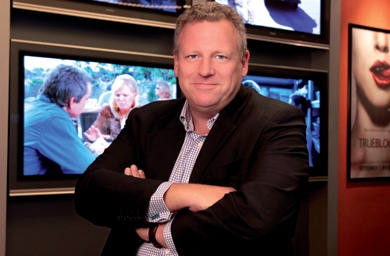
Jonathan Spink can be something of a showman, in public at least. At the official launch of HBO HD in Hong Kong recently, the network’s Asia CEO literally ripped up his notes on the presentation in favour of a short, casual speech.
Spink will be putting his presenting skills to good use again this week as the Casbaa (Cable and Satellite Broadcasting Association of Asia) Convention brings together the region’s pay-TV industry. He is one of the organisation’s board members, and HBO - now one of the pay-TV industry’s leading lights - is hosting one of the week’s parties.
Spink will be putting his presenting skills to good use again this week as the Casbaa (Cable and Satellite Broadcasting Association of Asia) Convention brings together the region’s pay-TV industry. He is one of the organisation’s board members, and HBO - now one of the pay-TV industry’s leading lights - is hosting one of the week’s parties.
So it’s a surprise to learn that Spink never planned a career in the media industry. He admits he fell into television by chance. The son of a teacher and a civil servant, the Briton started off studying international relations and politics. His first taste of media was spending a brief time, just “because he wanted to”, in a recording studio as head of sound effects after graduating from college.
It didn’t take him long to realise that recording radio ads was not his life’s ambition, but from there he stuck with media. His big break was a move to UK satellite operator Sky Television in 1985.
One-on-one, Spink is good company - to-the-point and honest. “Meeting with Jonathan is always efficient. He’s sharp, fast and direct,” confides one pay-TV executive. “He enjoys the better things in life. He’s an expert in wine and watches.”
Sport, however, is what brought him to Asia, even though he claims to play “bad golf and bad bridge”. Spink’s first role in the region was a five-year stint in Japan as executive vice-president for Liberty Media’s J-Sports and J Sky Sports.
Spink has now been with HBO Asia for six years, based in Singapore. At the time he joined, HBO in the US had already gained a reputation for high-quality, original programming on top of its movie service through hits such as The Sopranos and Sex and the City.
In Asia, the company operates as a joint venture between Time Warner and Viacom. Under Spink, HBO Asia has expanded from two to six channels; HBO HD, the latest addition to the line-up, is now live in Hong Kong, Taiwan, the Philippines and Singapore.
Its Asian strategy still follows the model of the US. The channel offers a commercial-free programming line-up delivered to paying subscribers via pay-TV platforms. The exception is HBO South Asia (also under Spink), which is a separate operation and runs ad breaks.
More is to come out of HBO Asia later in November, with the channel promising more partnerships with subscription-based platforms in Asia-Pacific.
Content in Asia is still drawn from the US. Localised programming remains difficult as HBO offers a regional feed; if it wanted to run any locally produced content, the shows would have to be relevant for the entire region.
Unsurprisingly, Spink is a staunch defender of the subscription system; indeed, he is quick to criticise media owners who give their content away. “Personally, I think people rush down that route too quickly. They’re thinking that the advertising model is a wonderful thing and could make millions of dollars,” he says.
Viewers in the US, he continues, expect to pay for HBO in return for the quality of content it delivers. Channels surviving on the support of ads will result in a “self-fulfilling prophecy”, he adds. “No one is willing to spend hundreds of millions of dollars to put it on YouTube.”
On that subject, he is supportive of Rupert Murdoch of News Corp, who he argues has set a good example for paid content in the newspaper industry.
A bigger concern for Spink is keeping up with HBO’s audience base. He says there is a danger of channels becoming older as the audience gets older. The rebrand of Cinemax as Max is the latest Asian business development. HBO is using Max to target a younger audience, especially males.
Spink is certainly a traditionalist on some subjects. For example, at a time when many pundits focus on the challenges facing TV, Spink argues that “the power of sloth” will keep the medium relevant.
“There is a comfort factor to television which people underestimate,” he says. Even with a pile of DVDs to choose from, in Spink’s point of view, after a long day of work, “do you actually want to bother thinking about which DVD to watch?”
And despite fears of a young generation who no longer watch TV, Spink points to the change in people’s lifestyles once they start working and have a family. This, he argues, will stop people living around their own activity and make them move back to the living room - where the TV is.
Spink also admits he is “a bit of a cynic” about mobile TV. He speaks of the industry investing heavily in the sector, but the frenzy being mainly driven by technology companies. “Because [the mobile companies] say it is possible, so there is a business. But no one has come up with a business model yet,” he argues. Even in markets such as Japan and Korea, with high-tech mobile networks and handsets, he is sceptical about how much people will watch movies or hours of TV on small screens.
Nevertheless, HBO Asia is not resting on its laurels. In the US it entered the on-demand market early on, and in Asia it is now looking into video-on-demand to complement the regular HBO channel. At present HBO On Demand Asia is a value-added service, free to premium subscribers in Hong Kong and Singapore.
At a time when the TV industry is under growing pressure around the world, Spink’s confidence in the medium is refreshing. And when asked if he has any advice for newcomers to the industry, he answers sarcastically: “Oh dear, I would go into banking.”
Jonathan Spink’s CV
2003 CEO, HBO Asia (Singapore)
2001 President, Europe, World Sport Group (London)
1996 Executive vice-president, J-Sports and J Sky Sports (Tokyo)
1990 Vice-president, Prime International, Liberty Media (London)
1985 Various roles, Sky Television (London and Amsterdam)
1983 Head of sound effects, John Wood Studios (London)
Got a view?
Email feedback@media.asia
This article was originally published in 5 November 2009 issue of Media.