The work consisted of films that cleverly used humour and cultural relevance to show Japanese audiences how "unbelievably" easy it is to use Canva.
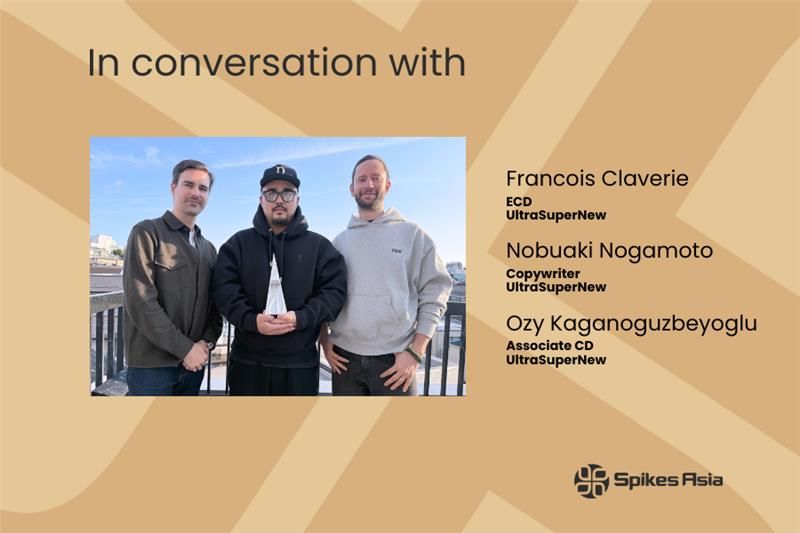
We spoke with Francois Claverie, executive creative director, Nobuaki Nogamoto, copywriter, and Ozy Kaganoguzbeyoglu, associate creative director at UltraSuperNew, to find out how Canva made its mark in Japan.
1. Talk us through the casting process. How did you decide who would work best for your 'high-context' approach?
Francois Claverie: The “Make it Unbelievable” idea led us to ask ourselves: which A-lister would the public love to see getting annoyed at a friend or colleague for not believing they designed something unbelievably good on their own, using Canva. Kitano came to mind immediately. His frustration could naturally see him slip into one of his on-screen personas: a short-fused mobster or a period-piece warlord, all with sinister consequences. To face his wrath, we turned to Gekidan Hitori, a comedian and director (he directed Kitano’s biopic), and a self-proclaimed Kitano admirer. The existing senpai-kōhai (mentor-junior) relationship between the two celebrities made for the perfect dramatic setup.
2. Properly understanding this campaign requires a certain level of cultural understanding, e.g. the inside jokes, the “senpai-kohai” relationship, etc. Were you nervous the diverse Jury wouldn't get it?
Nobuaki Nogamoto: In developing our idea and concept into a script, we paid close attention to cultural relevance while making a conscious effort to keep the humour light and accessible. The goal was for the jokes to land even without deep cultural knowledge, and to feel even more rewarding for those who had it. So, we were less concerned with strict comprehension and more focused on whether the humour simply worked.
3. Humour and cultural relevance are central to 'Make it Unbelievable'. How do you think these elements contributed to the campaign’s success in showcasing Canva’s accessibility and empowering users to create beautiful designs effortlessly?
Nobuaki Nogamoto: We believe humour lowered the barrier to entry, making Canva feel more approachable rather than intimidating. This was especially important as it was Canva’s first large-scale campaign and the brand was still new to the Japanese market. By embedding this humour in culturally familiar situations, we helped audiences quickly grasp Canva’s accessibility and its core value proposition: That anyone can create high-quality designs without prior design experience. Together, these elements were key to how we effectively delivered our message to the audience.
4. Why did you prioritise entering 'Make It Unbelievable' into Spikes Asia?
Francois Claverie: We are very selective when it comes to award shows. As an independent agency, we don’t have a large budget earmarked for entries. In APAC, Spikes are some of the highest creative recognitions one can clinch.
5. What does winning a Spike for the first time mean to you, especially as an independent agency?
Ozy Kaganoguzbeyoglu: Collectively speaking, it reaffirms our agency’s ability to create work that stands out and gets talked about. Categorically speaking, it’s deeply satisfying to know that we entertained those who watched these Canva films all the way to the end.
6. Having entered the Awards over the last few years, what have you learnt through the entry process? Is there anything you did differently this time?
Francois Claverie: Looks like we showed up with a stronger piece of work this time!
7. Drawing from your experience, do you have any advice for other Japanese agencies considering entering Spikes Asia, especially independent ones?
Ozy Kaganoguzbeyoglu: Our experience of submitting various types of work taught us to keep two important things in mind. Firstly, the work doesn’t speak for itself—people interpret it. Therefore, the core message and the insight should ring a bell, if not globally, then at least across the region, so the work has a better chance of grabbing the judges’ attention. Secondly, there’s the necessity of being smart when it comes to using the allocated budget versus the number of award categories you submit the work to. As an independent agency, you only have a few shots to make noise in a landscape where giants scream and pour out award budgets by default.
Entries into Spikes Asia are being accepted until Thursday, January 29, 2026. Get started on your entry journey at www.spikes.asia/awards.