
In global marketing circles, there’s a saying that the world is divided into just two markets: China and the rest of the world. As Chinese brands expand abroad, they champion a "glocal" approach, combining global brand power with local partnerships and customisation. That same strategy has now become the playbook for multinationals striving to grow and compete in China.
Global fast-food giants are racing to localise in China, following the sell-offs of major stakes in Starbucks and Burger King to local investors, mirroring the localisation strategies ofMcDonald's and Yum China over the past decade.
In early November, Starbucks finally unveiled a reshaping of its China strategy with a landmark deal: agreeing to sell a 60% stake in its mainland operations to local private equity firm Boyu Capital. With Starbucks retaining a minority interest and future licensing income, the deal is slated to close in 2026, subject to regulatory approval.
Within one week, Restaurant Brands International (RBI) announced another joint venture with Chinese asset manager CPE to operate Burger King in China. The deal gives CPE an 83% stake and a $350 million investment commitment, while RBI retains 17% and a board seat. The new partnership follows RBI's $158 million buyout of former partners TFI and Cartesian Capital earlier this year, when RBI had already started looking for a local operator to drive growth.
Both brands' new joint ventures came with ambitious plans for marketing, menu innovation, and aggressive expansion amidst soft consumer demand and intense competition in the world's largest market and 2nd-largest economy.
Behind the JV's announcement, they are following a familiar playbook for China expansion, that is, finding a local partner and investor to drive deeper localisation, which is similar to what McDonald's did over eight years ago, a strategy that has proven successful with sustained growth.
This summer, the fast-food giant released a report marking the eighth anniversary of its transition to a developmental licensee model under the "Jin Gong Men" (Golden Arches) banner. Since its 2017 acquisition by a consortium led by CITIC Capital, McDonald's China has rapidly scaled up, more than tripling its store count to over 7,100 outlets across 280 cities as of August.
What's more, McDonald's has a more ambitious plan to open 1,000 new stores each year and reach up to 10,000 locations by 2028. This growth will be supported by innovation and localisation, according to Phyllis Cheung, CEO of McDonald's China.
McDonald’s entered the Chinese mainland market in 1990 with its first outlet in Shenzhen. KFC, however, had already established a foothold three years earlier, opening in Beijing in 1987. By the end of September 2025, KFC had expanded to more than 12,600 restaurants across 2,500 cities nationwide.
KFC’s parent company, Yum China, was spun off from Yum! Brands in 2016, becoming an independent, publicly traded entity, which has since accelerated its localisation strategy, moving faster and deeper into the fabric of the Chinese market.
In November, Yum China announced ambitious growth plans, targeting the opening of around 1,000 new stores annually. The company aims to reach 20,000 locations by 2026 and 30,000 by 2030. Executives highlighted flexible store formats and a hybrid model of equity and franchise ownership as key drivers of faster expansion and deeper market penetration.
With four big players all navigating a similar path of localisation and competition in the same market, the question is whether more global brands can successfully follow suit and thrive in China. What lessons and pitfalls lie behind these localisation strategies in marketing and branding? Campaign spoke with marcomms experts to unlock the latest moves by global brands.

L-R: David Ko, Olivia Plotnick, and Jacob Cooke
Global brands push innovation yet risk falling behind local rivals
Earlier this year, Olivia Plotnick, the founder of the Shanghai-based marketing and consulting agency Wai Social, shared an op-ed with Campaign readers about her 60-day trip to 30 lower-tier cities in China. This journey revealed the realities of retail in the country.
She concluded the story with an important takeaway and posed questions for brands entering the Chinese market. "After spending 60 days outside of China’s megacities, it is precisely because of all that I have seen that I acknowledge any sweeping judgments, or lofty takeaways run the risk of perpetuating the very thinking that's causing foreign brands to struggle in the first place."
When Campaign asked her for her thoughts on Starbucks' localised marketing strategy and what should be done for the new JV model, Plotnick was impressed by the brand's nuanced cultural moments and its strategy targeting Gen Z.
She mentioned "the hype during June of 2025 surrounding the Jiangsu Provincial City Football League, where football was transformed into a celebration of local identity, grassroots participation and friendly city-level rivalry". Starbucks seized this moment to introduce city-themed drinks, encouraging fans to cheer for their hometown teams on Xiaohongshu and in stores and offering perks like free size upgrades for customers who support their city’s team.
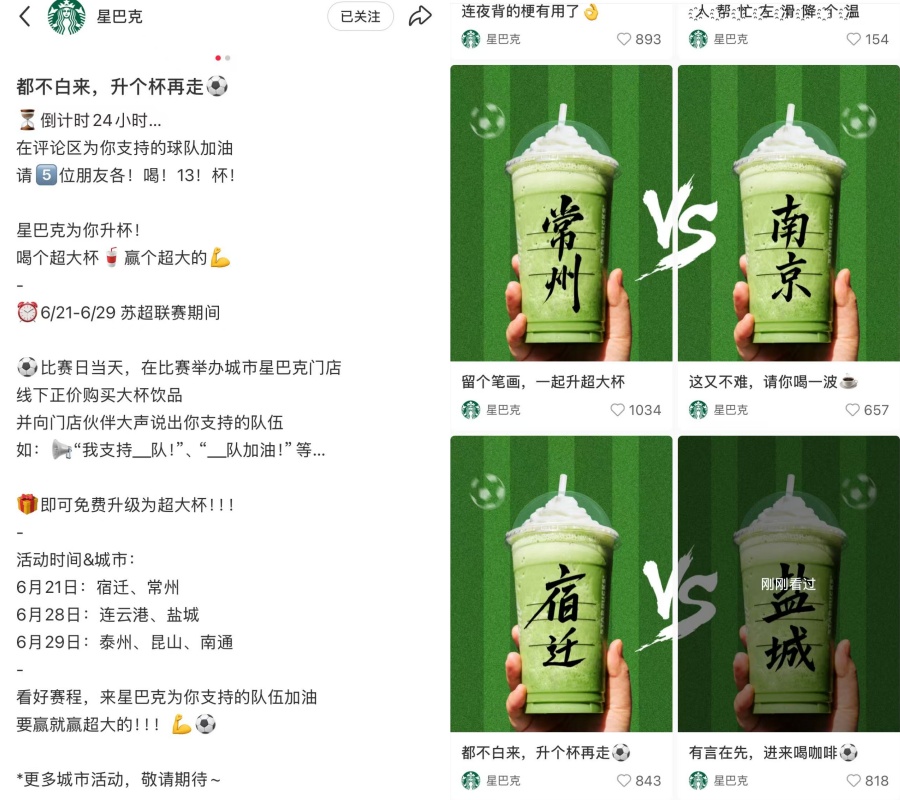
Starbucks & Jiangsu Provincial City Football League
Plotnick also shared that, on RedNote (known as Xiaohongshu), Chinese Gen Z has been seeing Starbucks post photos of its products accompanied by seemingly random combinations of numbers and letters. These codes are designed for Gen Z, who are eager to decipher them. It turns out that the codes correspond to product names or phrases. For example, "NT1b" can be interpreted as 拿 (Na) 铁 (Tie) 1 (一) b (杯 bei), which translates to "one cup of latte," while "Happy7fly" breaks down to Happy (快乐) 7 (七, pronounced 'qi,’ meaning 'seven'and 'take-off') and fly (飞).
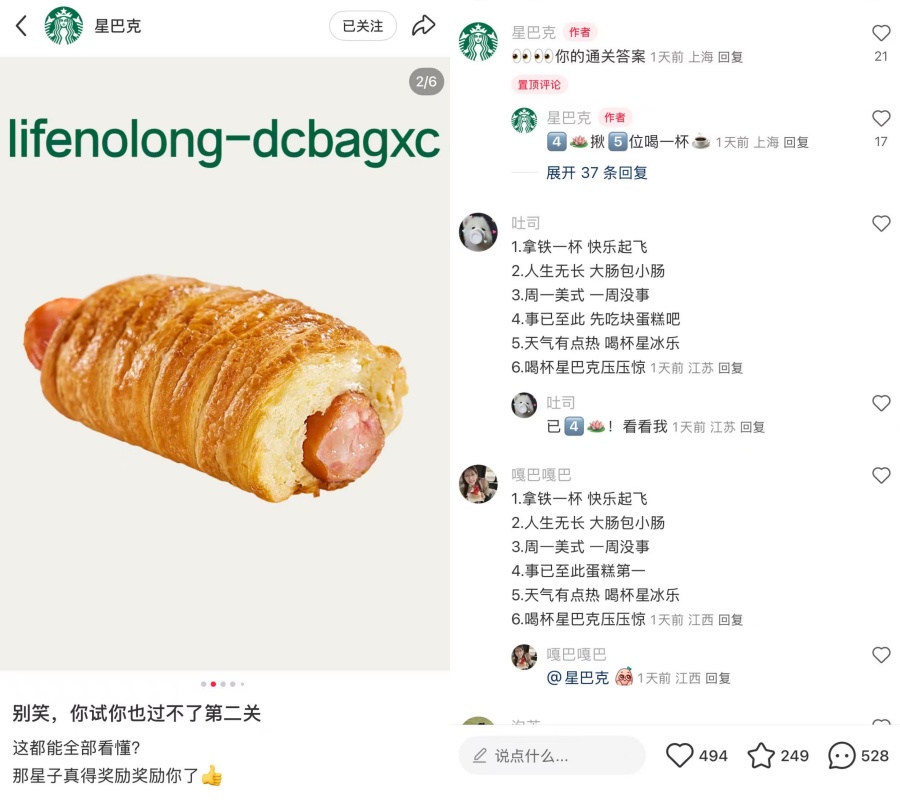
Starbucks & Gen Z codes
However, she noted that Starbucks has "underestimated the force of China speed. Now with the new JV, it will be crucial for them to understand what they can compete on, whether that’s product, pricing or experience — because at the moment, they’re no longer winning decisively in any of those categories".
David Ko, who headed Runder Finn Interactive Asia for the past nine years and later launched Humantyze as founder and lead advisor, observed that even before the buyouts, both Starbucks and Burger King made significant efforts for the local market, such as Starbucks launching 78 new products in 2024. Under its new CEO, Molly Liu, Starbucks is undergoing a rapid transformation with accelerated product velocity.
After the RBI took complete operational control in February 2025, it invested over $100 million and brought in executives from Yum China, McDonald's China, and Starbucks. However, Ko also thought that the"recent partnership with CPE signals renewed emphasis on digital marketing and community engagement".
Digital marketing and data optimisation define the next battleground
When it comes to digital marketing and mobile app development, brands can learn a lot from McDonald's and Yum China. Jacob Cooke, CEO of WPIC, noted that these brands have created "a far tighter loop between consumer behaviour, digital engagement, and in-store activity than what we typically see in Western markets".
He explained that here in China, "mobile apps and loyalty programs are not just transactional tools—they’re full digital ecosystems. In China, these platforms integrate ordering, payments, personalised coupons, location-based offers, membership tiers, and limited-time flavour drops, all of which generate an enormous volume of real-time consumer data. That data feeds directly back into product development and marketing, allowing these brands to push highly localised promotions—whether it’s Chinese-style breakfast items or region-specific seasonal menus".
Cooke elaborated that the core lesson is that localisation today is "primarily digital". The brands that succeed are the ones that operate at the same pace as local competitors and build "China-specific user journeys, loyalty funnels, and content systems" rather than relying on global playbooks. "Chinese consumers expect extremely fast iteration: rapid product testing, personalised pricing, and always-on content", he added.
Cooke further shared a typical example in Chinese digital marketing. With data and marketing insights, brands still need to combine localised storytelling, sharp audience segmentation, and platform‑native execution, such as when a premium blender maker, Vitamix, cracked consumers' minds in China with livestreaming designed for the local audience to show how its machines could simplify everyday local recipes, such as soy milk, soups, porridge, nut milk, and children's snacks.
Even though the blender is still a niche appliance, focusing on three fast‑growing consumer groups, including health‑conscious young families, amateur home chefs, and fitness‑minded urban professionals, has turned Vitamix into a lifestyle essential. He summarised that "data, speed, and localised digital ecosystems are the true differentiators".
Traps from yesterday and takeaways for tomorrow’s brands
Plotnick emphasised the importance of authenticity in localisation. "Foreign brands shouldn't force themselves into cultural moments that don't feel authentic or stretch too far from their brand identity. The goal is not to imitate Chinese brands, but to understand what unique value you bring and express that in a locally relevant way".
She pointed out that "data from Tmall during the latest Double 11 festival shows that international brands continue to dominate in trust-heavy categories such as supplements, wellness, mother-and-baby, and beauty. That's a reminder that localisation doesn't mean abandoning your global strengths—it means adapting them thoughtfully to the market, not trying to become something you're not".
Cooke stressed that rather than "swapping ingredients or changing packaging," the deeper challenge lies in organisational adaptation. This involves accommodating China's fast pace, data transparency, and platform culture. "Many brands hesitate to deviate from their global KPI structures or creative guidelines, and as a result, they launch campaigns that feel generic, slow, or insufficiently tailored to local preferences", he said. He also highlighted another common mistake that is "treating platforms interchangeably; in China, each one—Tmall, Douyin, Xiaohongshu, WeChat—plays a different role, across the funnel".
Ko noted that "localisation in China remains "a minefield where well-intentioned strategies often backfire." He highlighted several pitfalls, including the "Chinatown Aesthetic," where companies mistakenly believe that using symbols like red and gold, dragons, and lanterns will make a product feel local. This approach is often dismissed by Gen Z as "tu," meaning "uncool" or "tacky." He also mentioned the issue of "Phantom Translation," where literal translations overlook cultural nuances. For example, Nike's "Year of the Monkey" shoes used the characters Fa and Fu in a way that inadvertently translated to "getting fat."
Furthermore, Ko pointed out that misunderstandings related to platforms can also be costly. The "Platform Arrogance" trap occurs when Western marketers drop Instagram-style content into Chinese ecosystems like WeChat or Xiaohongshu. This oversight neglects the fact that these platforms operate on algorithmic seeding, private traffic, and trust-based discovery. Without private WeChat groups, brands may end up "shouting into the void."
In a market where sentiment can shift overnight, Ko emphasised the "Values & Politics" landmine is particularly volatile, with brands learning the hard way that "political neutrality is not an option," as even a dropdown menu listing Taiwan or Hong Kong as separate countries has triggered significant crises for global names like Marriott, Delta, and Zara.
Ko believes that "ceding majority control to local partners represents a profound strategic shift from the traditional franchise model. Both Starbucks and Burger King have acknowledged that local partners are no longer subordinate executors but co-pilots with decision-making authority over strategy, product development, and market positioning".
He explained that the ability to adapt quickly and deeply localise is crucial. "The ability to test, learn, and iterate rapidly through local teams gives brands critical advantages against nimble domestic competitors". On the other hand, "Gen Z seeks brands that understand Chinese culture deeply rather than importing Western lifestyle concepts", he added.
Ko also highlighted the unique social commerce capabilities of Chinese platforms, such as sending digital coffee vouchers through WeChat. When recipients can share with friends, it will create "viral distribution loops and transform customers into brand advocates". This strategy has led to what Starbucks refers to as "member sales ratios" of 73%, meaning nearly three-quarters of sales come from digitally engaged members.