Profits for the three months to June fell to 354 billion yen (US$3.2 billion) from 492 billion ($4.6 billion) in the same period in 2007, while quarterly sales were down four per cent to 6.2 trillion yen ($56.8 billion).
Toyota has also scaled back its ambition to become the world’s first automaker to sell 10 million vehicles a year when it readjusted its global sales target for 2009 to
9.7 million vehicles, down 700,000 from the previous goal - a sign that the motoring giant is expecting leaner times ahead.
The good news for Toyota is that it is faring better in emerging markets, as sales in Asia were up 18 per cent by 40,000 to 262,000 vehicles. Sales in its home market Japan were also up slightly by 12,000 vehicles, or 2.4 per cent, to 512,000.
The car firm is using this lull period to re-examine its manufacturing operations and to develop more hybrid and fuel-efficient vehicles to ride out the ongoing fuel crunch as competitors such as General Motors continue to struggle with fuel-guzzling vehicle line-ups that include trucks and SUVs.
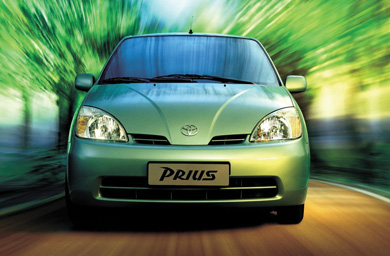
At a time where growth has slowed to just one per cent, Toyota is revisiting its company philosophy of ‘lean manufacturing’ and ‘just-in-time production’. Meanwhile, as green concerns dovetail with high fuel prices, it is banking on hybrid vehicles. The company has a goal to sell a million hybrids a year by 2010. It will unveil its latest Prius fuel and electric hydrid in 2009 and is developing a hybrid for its Lexus line while plans are underway to introduce an electric car by the next decade. But will this be enough to offset the slump?
| FACT BOX |
| - The car maker’s stock has fallen around 50 per cent this year and the firm is set for its worst annual performance in 33 years. - Toyota also recently lost its spot as the world’s largest carmaker by market capitalisation to Volkswagen. - Its Q1 profits fell 28 per cent to 354 billion yen (US$3.2 billion) as sales slipped four per cent to 6.2 trillion yen ($56.8 billion). - Toyota’s growth rate has slowed to one per cent in 2008, compared with six per cent in 2007. |
Neil Hudspeth, CEO Asia-Pacific, The Brand Union
Despite the establishment of the Toyota brand in 1936 by founder Sakichi Toyoda, it was not until the launch of the Corolla in 1966 that the brand firmly positioned itself on the world’s stage.
In fact, the Corolla defined the platform for the entire Toyota brand, and with almost 100 vehicles currently in its line-up, the core ideals of the Corolla - reliability, affordability and safety - are still very much intact and help drive the brand’s success around the world. The launch of the latest Corolla earlier this year contributed hugely to growth in Russia, Australia, the Middle East and Indonesia.
To complement these values, Toyota has invested a great deal of time and money in CSR in the past decade, with technology and innovation leading the way for greener and safer products. Its hybrid vehicles are arguably market leaders, and certainly embellish the brand with market-relevant values.
In the current economic climate of fluctuating currencies, rising raw materials costs and subdued consumer confidence, its strategy is to increase supply of models in high demand and launch new ones. With the brand in a state of health, the challenge is whether the business strategy will dilute the brand through further extension.
Pratik Thakar, executive VP, McCann Worldgroup China
The reality of these difficult times is that businesses need to be realistic. Car marketers need to look again at their portfolio mix to produce the right model and marketing that’s in line with current consumer needs.
Toyota doesn’t need to break any world records, but to bring the right product to its loyal customer base and once again prove its agility as an organisation.
This is the perfect time for manufacturers to go back to the Japanese manufacturing philosophy of Kizen - to bring innovation and efficiency into business. Many Japanese brands that wavered from the Japanese ‘efficiency-driven’ model to pursue the Western ‘ambition-driven’ model need to go back to basics. It’s not about who makes most cars, it’s about the profit per car.
The next 18 months will see the need for a ‘people’s car’, not just in developing economies but even in the US and Europe. Efficiency and efficacy will be the buzzwords as consumers look for reliability, small sizes, easy maintenance and fuel efficiency for their vehicles.
Toyota has the highest authority in developing the ‘no fuss’ car. It has the technical capability, company culture and right brand image to do it.