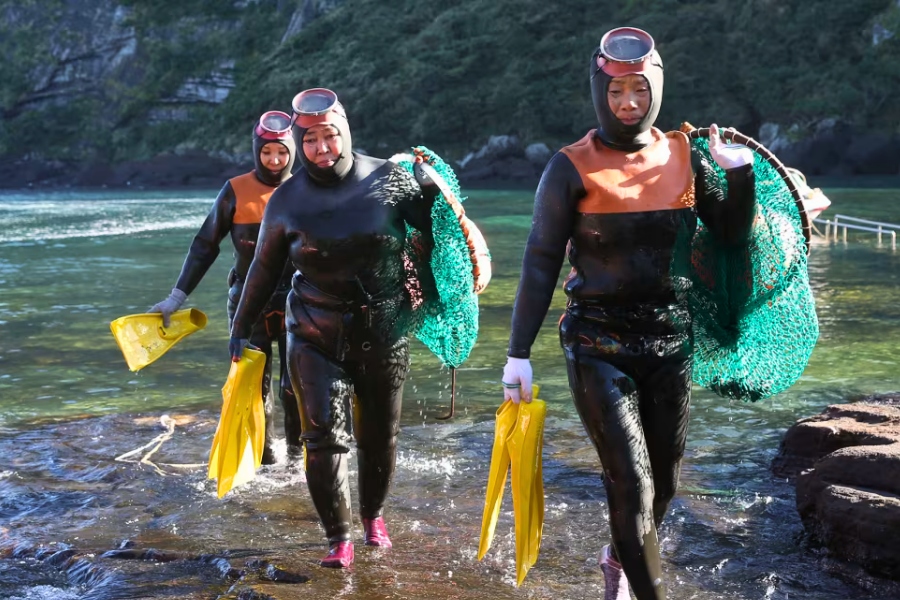
50 miles off the southern tip of the Korean Peninsula is Jeju Island: home to a unique sea culture and a celebrated community of women, the Haenyeo. Haenyeo literally translates to 'sea women'— generations of Korean women divers who are trained from adolescence to dive to the seabed as much as 60 feet (18 meters) beneath the surface multiple times over the course of four to five hours each day to harvest food.
They dive throughout pregnancy and well into old age, without the help of any breathing equipment —just a wet suit. The physiological resilience of the Haenyeo DNA—the ability to go off oxygen for so long has been a scientific curiosity. Scientists have often wondered whether this endurance is the result of lifelong training, genetic adaptation, or a combination of both.
Historically, haenyeo look out for one another in close groups; the cooperative practice is known as sunooreum (watching each other’s safety at sea). But with modernisation, as their numbers shrink and divers spread out across the water, this informal safety is a dangerous one. Cardiac arrests, especially in older divers and other accidents, have become a growing concern.
To address this risk, creative agency Cheil and the Jeju Institute of Korean Medicine have developed a real-time digital surveillance device called the Haenyeo Safe Buddy app. The app connects to smartwatches and continuously monitors heart-rate data throughout the dives.
The app looks for any abnormal patterns that may indicate distress and automatically sends an alert to other haenyeo within a one-kilometre radius to begin the first response. The first four to six minutes after a cardiac event, a period cardiologists call the 'golden window', are crucial for survival. Early help during this period can be the difference between life and death. Cheil tells us that emergency services average around seven minutes in Jeju’s coastal waters.


In more serious cases, divers can manually trigger an emergency button to send coordinated alerts to the local fishing village association and Jeju’s emergency response centre to mobilise onshore support.
The app was introduced in March 2025 and has since been adopted by around 300 haenyeo. In the ten months since launch, there have been no reported fatalities among users being monitored. However, we also don't know how many divers required emergency aid in this period, so the full impact of the tech still needs to be understood.
"We hope this new solution will help preserve the tradition of our cultural heritage and contribute to their safety for generations to come," said Hee-chul Ko, R&D team leader, Jeju Institute of Korean Medicine.
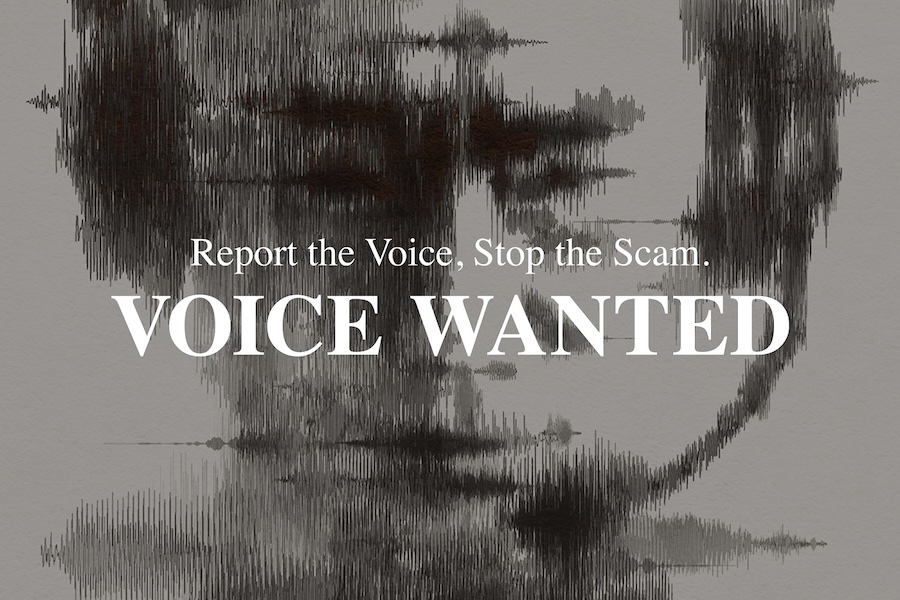
The initiative follows Cheil's social campaigns Knock Knock and Voice Wanted, which turned tech into lifelines that protect vulnerable people from harm. The former campaign was APAC's most-awarded in 2023 and clinched the prestigious Cannes Glass Lion Grand Prix.
CREDITS
Campaign Title: Haenyeo Safe Buddy
Client: Jeju Institute of Korean Medicine
Director, Min-ho Song
R&D Team Leader, Hee-chul Ko
Researcher, Jae-won Kim
Researcher, Ye-Ji Lee
Creative Agency: Cheil Korea
Account Director: Wonjun Jang
Account Executive: Yoonil Na, Sein Chung
Creative Director: Jaehyuck Lee
Art Director: Yerim Han
Copywriter: Drew Botcherby
Production: MBC CHUNG-BUK