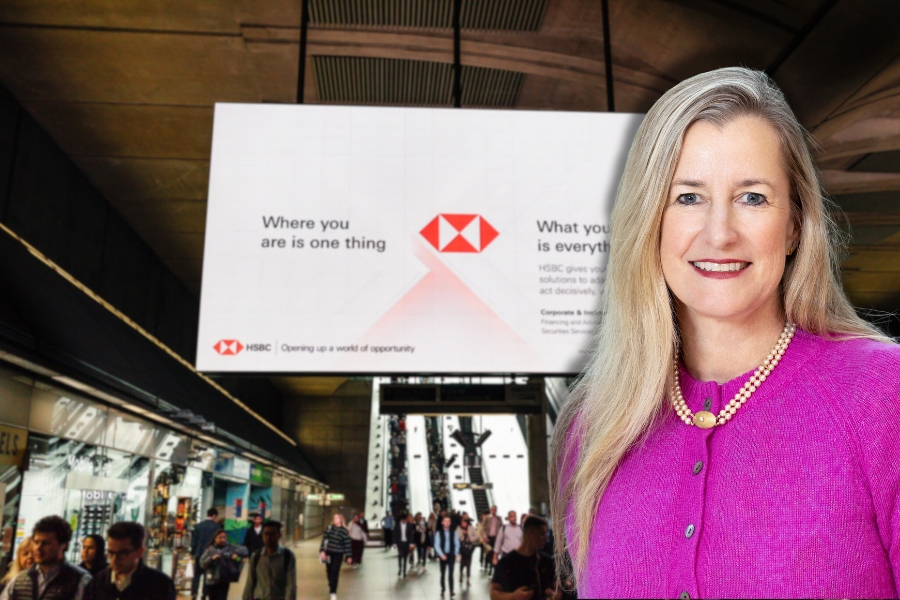
If you’re a bank the size of a small country, with a history stretching back to the 19th century, how do you convince anyone you’re special? For years, HSBC’s answer was simple: we’re everywhere—The World's Local Bank. But when every competitor with a skyscraper and a logo also claims to be global, ubiquity is no longer a differentiator.
That insight sparked HSBC’s first-ever global OOH campaign for its corporate and institutional clients across 20 markets, including the UK, the US, Hong Kong, Singapore and Southeast Asia, India, Latin America, the UAE and key European markets. Titled 'Here for the now. Here for the next.', the campaign is the bank's biggest marketing investment in a single business line to date.
In January, HSBC folded Commercial Banking and Global Banking & Markets into a single entity, Corporate and Institutional Banking (CIB). On paper, it was a classic bit of corporate housekeeping that group head of marketing, IA and global head of corporate and institutional marketing, Nicole German, says, demanded a story.
“What clients wanted, especially after a few years of nonstop economic and political drama, was stability, resilience, and real expertise. From a marketing perspective, we wanted to bring that to life—to show clients, prospects, and even our own employees that HSBC is a partner for the long term,” she says in her exclusive chat with Campaign Asia-Pacific during her recent trip to Hong Kong.
The art of saying less (in red and white)
The brief to VML, HSBC’s longstanding creative partner, was to clarify the value of CIB for every audience that mattered. The work needed to double up as an identity project, commercial playbook and morale booster for long sales cycles. Any campaign that didn’t speak directly to those themes would risk fading into the background noise.


German is frank about the creative approach: “We didn’t chase every single insight but focused on what mattered most. We wanted to be highly relevant to today, stand out from the competition, and keep the message simple.”
That meant leaning hard on HSBC’s iconic visual DNA—the signature red and white hex B, whilst dodging the graveyard of financial clichés like “trust,” “partnership” and “connectivity.” As German put it: “Compared to competitors with lots of imagery and words, we deliberately kept the messaging clever and clear.”
Airports, a natural hunting ground for corporate clients, are notorious for wallpaper finance ads—think generic slogans about growth, purpose, or partnership. HSBC’s gamble was that stripped-back design and sharp copy would stand out. The early evidence suggests it has.
“In the pre-campaign testing of the creative assets, we actually saw 91% likeability, well above the financial services average of 58% with a strong affinity of 8.3 out of 10, versus a 6.5 out of 10 benchmark for financial services,” German explains.
The global version of the OOH campaign went live in June, and the regional markets in Asia are rolling out in phased iterations.
VML led the creative, OMG handled media planning and buying, and regional teams co-shaped execution to ensure the global idea could flex to local nuance. “The work wasn’t built at global headquarters—we brought regional teams into the process. That collaboration ensured the campaign wasn’t too global in nature, but could adapt to local relevance.”
Execution is deliberately omnichannel: airports and OOH for visibility; digital amplification through HSBC’s 267,000-strong LinkedIn CIB audience; thought leadership in earned media, surveys, and reports for credibility; and live activations from webinars to flagship conferences.
Measuring beyond impressions
“From a brand-and-demand perspective, we’ve got various levers. Our focus is on awareness and consideration, but also trust: would you consider banking with HSBC, and do you trust us as a partner?”
That trust is famously hard to quantify, so the team built what she calls a “measurement stack.” It starts with the obvious brand pulse, as German said, awareness, consideration, trust, but then drills into indicators that actually matter in a CIB context. HSBC’s share of voice on topics like trade and tariffs, for example, leapt “from about 8% to 30% over a matter of weeks.”
From there, the campaign is judged on engagement (reach, content interactions, digital enquiries), and the pipeline influence—“frontline sentiment, engagement, deals, and marketing-influenced pipeline,” as German lists them. And unusually, internal alignment is a KPI in its own right: “We wanted employees to feel pride and have a rallying cry that resonated with clients.”
The approach also reflects the peculiar reality of CIB marketing. The client base is small, highly sophisticated, and spread across global markets. Sales cycles can stretch months, sometimes years. The role of marketing here is not to close deals overnight but to create the conditions for them: enhance awareness, generate credibility, and nudge open doors for frontline bankers.
Competition, differentiation and what next?
The competitive backdrop is fierce and noisy. JPMorgan has built a publishing empire of white papers and market briefings, designed to flood search engines and inboxes. Citi pushes hard into ESG research and convenes high-profile summits. Standard Chartered relies on its Asia-Africa footprint with its ‘Here for Good’ positioning. In that environment, HSBC is waging on subtraction: fewer words, fewer images, and a clear through line.
The risk is obvious—quiet can get drowned out. But the upside, if German’s KPIs hold, is that HSBC’s pared-back message will cut through and stick in the handful of boardrooms that matter most.
So, will this messaging be the bedrock for future CIB campaigns? “It’s early days, but yes, this is foundational. The aim is to keep evolving, surprising, innovating, and leveling up. A year from now, I hope we’re talking about how we’ve built on this.”