But inside China, their power may well linger.
I am looking out for a rash of babies born in 2008 with the names BeiBei, JingJing, YingYing, NiNi, and especially HuanHuan.
Why were these five mascots so powerful, while some mascots quickly become forgettable? Mascots are a powerful communication tool, allowing companies and organisations to express their values in a more human, emotional and memorable way.
I am looking out for a rash of babies born in 2008 with the names BeiBei, JingJing, YingYing, NiNi, and especially HuanHuan.
Why were these five mascots so powerful, while some mascots quickly become forgettable? Mascots are a powerful communication tool, allowing companies and organisations to express their values in a more human, emotional and memorable way.
But creating a character mascot is not an easy task. A successful design needs to embody the values of the company or brand it represents simply and naturally. It needs to connect in an emotional way, making the consumer see something inside themselves that is present, or inspirationally desirable. Then, when this Herculean design task is complete, it must be realised in three dimensions, in terms of form, size, and materials. Finally, the name serves as an important final element in the brand creation.
The magic of Mickey Mouse is the standard by which to measure all characters. There can be no formula for mascots given the emotional factors that prompt people to attach (or not attach) to them, but, quite clearly, Mickey Mouse creates magic with children. Children intuitively respond positively to the image of Mickey and Minnie, often before they can speak.
Over the years, the Olympic Games have spawned a hoard of mascots. The first such mascot appeared in 1972, when the Munich Games gave the world a dachshund named Waldi. Waldi personified the country, humanised the Games and represented determination - a value shared by the German people and the Games themselves. Not every Olympic mascot since then has been as successful. Most are forgotten after the Games, with few exceptions (Hodori the Tiger in Seoul, perhaps). One in particular is remembered for its spectacular failure. The 1996 Atlanta Summer Games gave the world Izzy, one of the most loathed fantasy creations in the history of character design. Izzy boldly defied global mascot convention. He represented absolutely nothing relating to the geography, culture or natural environment of the southeastern United States, nor to the spirit of the Games.
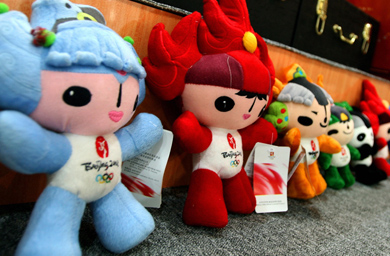
At this Summer Olympics, Beijing’s Fuwa have been a well-received family of mascots. BeiBei, JingJing, HuanHuan, YingYing, and NiNi are characters that fulfilled many requirements: they are five in number, which matches the number of Olympic rings (and the five colours of the rings). They also represent the five Chinese elements, and possess characteristics of the panda, Tibetan antelope, swallow, fish (many associated strongly with China) and the Olympic flame. And, when you say the mascots names in sequence, "Bei Jing Huan Ying Ni", it welcomes all to Beijing. Needless to say, this is a design that squarely met the client brief.
But the true magic of the Beijing Fuwa is their appeal to children. The names alone, using a rhyming two-syllable name, connect with the child in all of us, particularly in China and Asia. This naming element marries nicely with their colorful and playful design. Therein lies their magical connection with China and this year's big event.
Looking ahead, what will be the mascot of the 2012 Games in London? The British tend to be harsh critics of their own creations - evidence the outcry about their Olympic logo - so this will no doubt be a developing story of great interest. My bet is that it will be a hedgehog named 'Harry'.

Craig Briggs, managing director of Asia Pacific, brandimage Descrippes & Laga
cbriggs@brand-image.com