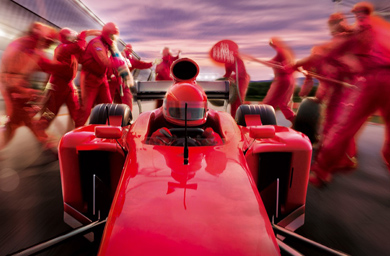
After a noticeably quiet run-up to the event, F1 sponsors, such as Johnnie Walker and ING, have started jockeying for position with local brands to exploit the novelty appeal of the competition’s first ever night race, and Asia’s first street race.
Headline race sponsor SingTel is using the event to gain global exposure. But insiders say Asia’s largest telco has had limited funds with which to leverage its sponsorship, which cost about S$20 million (US$14 million).
Last month's launch of the iPhone, fledgling pay-TV platform mio TV and the introduction of mobile number portability in the city-state have put serious strain on SingTel’s F1 marketing budget. Spend has been concentrated below-the-line: F1 simulators, mobile racing games and a 'grid girl' contest to find 'sporty' women to add some trackside glamour.
The contest has been turned into a reality TV show on MediaCorp's Channel 5, the race’s free-to-air broadcaster.
There have been no real attempts to ambush the Grand Prix by SingTel’s rivals. M1 teamed up with the Vodafone McLaren Mercedes team to stage consumer promotions in June, but these ended last month. StarHub has avoided Grand Prix-related marketing altogether.
The principal draw of the Singapore Grand Prix for sponsors is its international appeal. Most of the 100,000 tickets - which are now sold out - were sold to non-locals. And unlike the other three Asian Grand Prix, China, Malaysia and Japan - which attract the smallest global TV audiences on the Grand Prix circuit - Singapore’s night-time scheduling suits F1 fans in Europe, where the biggest audiences are.
This suits sponsors with global messages. Tag Heuer, which counts Singapore as one of its biggest sales-per-capita markets, has erected giant posters of British driver Lewis Hamilton in Orchard Road shopping district and has launched a special-edition watch. Johnnie Walker is using the race to activate its 'Join the pact' anti-drink driving campaign, with stunts to show off the skills of Finnish driver Mika Hakkinen. "The Singapore Grand Prix is an enormous opportunity for upmarket brands to hit Southeast Asian and European audiences," said Stewart Mison, the head of Initiative's London-based sports marketing consultancy Sports Futures.
"But the big question is: will this race be a one-hit wonder? It was widely predicted that the Shanghai Grand Prix would be huge. But it has limited appeal to Chinese because there is no local hero."
In Singapore itself, the Grand Prix has yet to generate huge interest, except from commuters and businesses complaining about the road closures in Marina Bay, where the race is being staged.
A Straits Times poll found that only 39 per cent of Singaporeans were excited about the event, while 58 per cent had no idea when the Grand Prix was due to be held. More than half felt that the event had been weakly promoted.
The event is likely to generate more buzz next week, just before the event, predicted Sharon Soh, strategy director of MEC Singapore. Posters and radio have been the main vehicles to advertise the Grand Prix.
"I don’t expect huge ratings," said Soh. "MediaCorp has bundled a cost-efficient spot buy package (S$20,000 for 15 30-second spots across various F1-related programming), so advertising spend around the event will be fairly contained too."
The Singapore Tourism Board, which is paying for most of the Grand Prix, is hoping the city will benefit as its cityscapes are beamed into Europe.
European countries accounted for 19 of the top 20 global markets in terms of ratings per race last year, according to Initiative figures.
It is the start of a trend for motor racing. With the prospect of Bernie Ecclestone bringing F1 to Korea, India and Indonesia, interest is rapidly shifting eastwards. �