
Effective online marketing means tailoring messages and experiences to individual needs and preferences. We should all know this by now. But such rigorous customisation requires access to large amounts of behavioural, attitudinal, and demographic site visitor and buyer data.
The more advanced marketers will augment this data with offline information from point-of-sales, catalogues, call centres and more. They also continuously analyse visitor and buyer data to better understand their target audience, optimise marketing budget allocation, and fuel marketing applications such as search engine marketing (SEM), email marketing, and product recommendations.
Typical (free) analytics systems track visits and revenues associated with visitors who click on marketing links, view promotional content or purchase specific products. But these solutions limit the scope of the analysis to the performance of the campaign. That is, they focus on the “visit” rather than the “visitor”. What’s critically missing in this approach is an understanding of individual visitor behaviour in the context of the campaign.
There are some in the industry who would tell you that it’s impossible to understand individual visitor behaviour using the technology available today.
I strongly disagree. Certainly, some people delete cookies, but that is not a valid reason to wave off the value of the technology. The reality is that most people retain cookies for quite a while. While some might clear them once a month or so, it is rare for people to delete cookies every day or more often than monthly.
How then, can we capture our “visitor”?
With the proper implementation of today’s technology it is very straightforward to combine both “cookie” information and “registration” data to build an ongoing profile of the people behind the clicks — the individuals — whether they use their home computer, work computer, mobile phone or an internet café to interact with your business.
Let me illustrate the value of having such a complete visitor profile. Suppose a company wanted to analyse the results they have on a recent customer-acquisition campaign. They purchased search keywords and had a site promotion with a discounted product.
For a deeper (and more meaningful) analysis, they would begin evaluating acquired visitors and asking the question: Who are they?
By defining visitor segments that responded to the search keywords, viewed the promotional offer and purchased the product, a marketer could identify exactly which audiences were effectively targeted by the campaign and also start to understand their behaviour.
As a result, they would be able to answer critical questions such as:
- Are they first-time visitors or frequent purchasers?
- What products doe they typically buy?
- What other products have they looked at previously and abandoned?
We can also do a more granular (and actionable) analysis by looking at narrower segments of visitors who participated in one or more campaigns and identifying their individual behaviour. Were they actually interested in the promotion? Were they interested in the product? Did they have difficulties navigating the website to find the product?
But why do we need to look at these narrow segments?
By drilling into segments of visitors who exhibited these behaviours and examining their paths through the site, an online marketer can understand why a campaign did or did not meet expectations, and how to better target this group of customers.
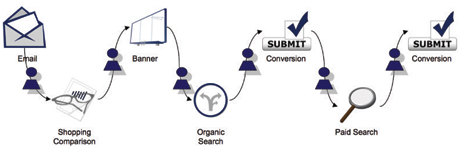
Building a profile of the customer relationship over time
Each marketing campaign is also an opportunity to find out something more about the customer. It is essential to capture this information and tie it into the rest of the data to build, over time, a more complex view of customers—both as groups and as individuals.
Now, if some form of site registration is required, such as a newsletter signup or even a sales enquiry form, it is important to take the information from that source and connect it back to all the previous knowledge you have from that visitor’s individual cookie to start growing the individual profile.
But with so many different profiles, how can we possibly tailor our marketing to each individual?
The analysis in the profile-mining scenario above is driven by the questions that online marketers ask. An effective web analytics solution must also be able to provide data on visitor behaviour based on open-ended questions as opposed to having to run a new campaign to capture the required information.
As a result, the business must be able to create different profile segments in the process of measuring the success of a single campaign. Since it is not possible to know ahead of time which visitor groups to analyse, it is important to have true profile-mining capabilities on hand. Remember, we want a complete picture of visitor and customer behaviour, not just a simple summary of the clicks or visits.
What is the value of lifetime customer profiles?
With lifetime profiles, businesses now possess a data asset comprising accurate, comprehensive and actionable information about their customers.
This invaluable information gives businesses the edge in audience targeting. Instead of just plainly capturing customer behaviour data, companies now are able to segregate their target audiences according to their profiles. From a marketing strategy perspective, they now know when, where, what and how to sell to different profile segments, and even increase the probability of success of their marketing campaigns.
This is the ultimate marketing edge that corporations need for success in today's ever-competitive landscape.
Disclaimer: I work as a marketing professional for IBM, but this opinion article is my own and doesn't necessarily represent IBM’s positions, strategies or opinions.